Choose a test user to login and take a site tour.
To continue using the site you need to read the revised version and agree to the policies
Search in Photos
Search in Albums
Search in Members
Search in Articles
Search in Blogs
Search in Businesses
Search in Events
Search in Groups
Search in Listings
Search in Music Albums
Search in Music Songs
Search in Pages
Search in Questions
Search in Quotes
Search in Recepies
Search in Thoughts
Search in Videos
Search in Channels
Search in Wishes
Search in Prayers
Search in Discussions
Search in Products
Search in Jobs
Search in Products
8 minutes, 23 seconds
-81 Views 0 Comments 0 Likes 0 Reviews
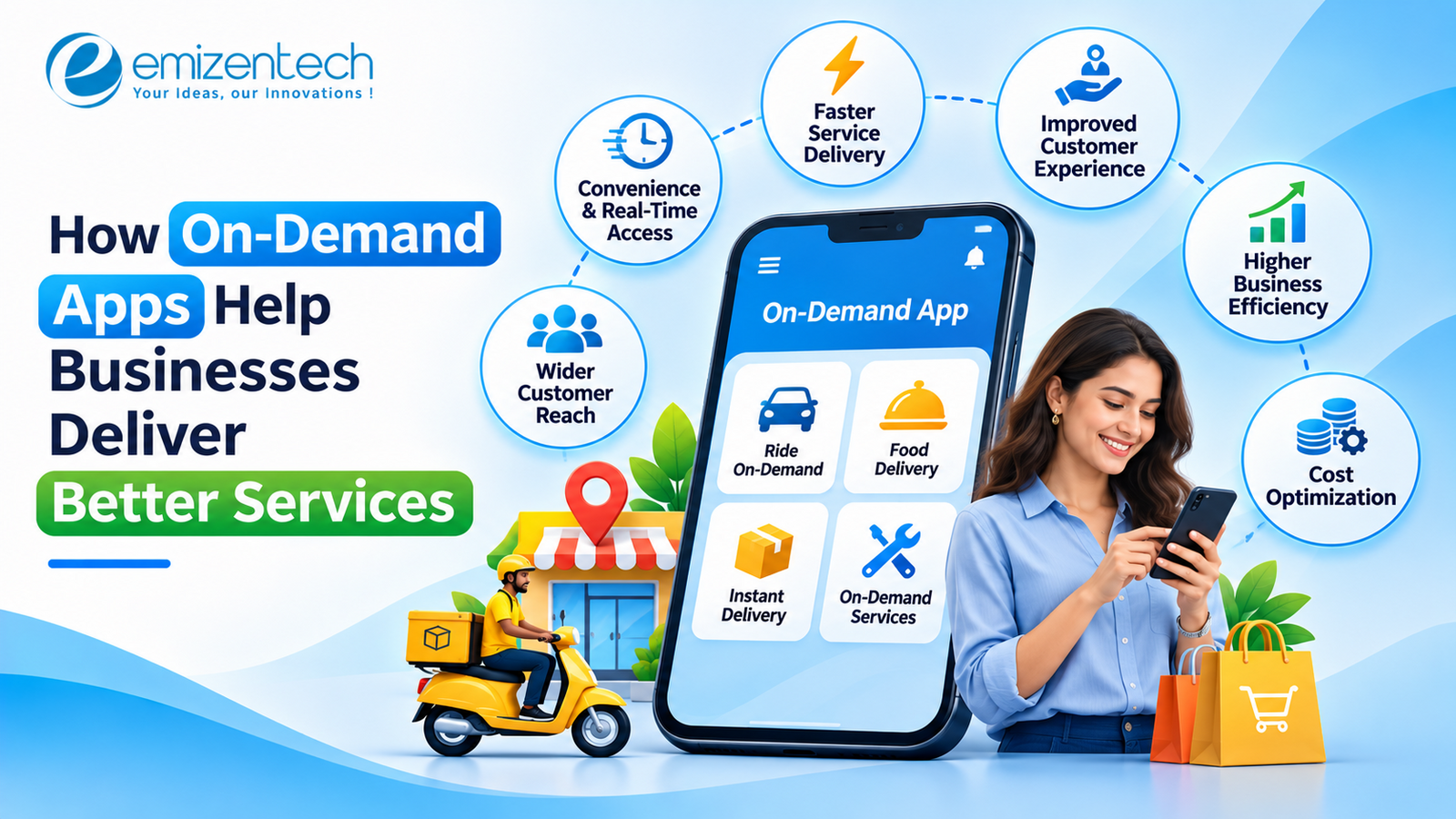
Businesses are increasingly adopting on-demand applications to make their services more accessible, simplify operations, and meet changing customer expectations. As digital services become more common, customers expect faster bookings, reliable updates, and convenient payment options. AI is also becoming an important part of this shift, helping businesses improve demand forecasting, automate customer support, and personalize service experiences. By combining these capabilities with efficient workflows, businesses can improve service delivery and prepare for future growth.
Traditional service models often depend on phone calls, manual bookings, and separate systems for managing customers and service providers. These processes can become difficult to manage as demand increases.
On-demand applications bring these activities into a single digital platform. Customers can request services, track progress, and make payments, while businesses can manage bookings, assign service providers, and monitor operations. On demand app development helps businesses create these platforms around their specific service requirements and operational workflows.
This approach helps businesses reduce manual work, improve coordination, and deliver a more consistent customer experience.
A well-designed application can simplify several stages of the service process, from the initial booking to final delivery. Businesses can use these capabilities to reduce delays, improve communication, and provide a more consistent customer experience.
Customers should not need to make multiple calls or send messages to book a service. An application can provide a straightforward booking process where users select a service, enter their requirements, choose a suitable time, and confirm their request.
For example, a home service business can allow customers to book plumbing or cleaning services directly through its app. This reduces the time spent handling requests manually and helps staff manage bookings more accurately.
Customers often become frustrated when they cannot determine the status of a service request. Real-time tracking provides visibility into important stages, such as order confirmation, provider assignment, and estimated arrival time.
Businesses can use tracking features to coordinate service providers and identify delays before they affect customers. This improves communication and reduces the need for customers to contact support for routine updates.
Manual order processing can create errors, duplicate bookings, and delays as service demand increases. Automation helps businesses manage incoming requests without depending entirely on employees to update records or assign tasks.
An application can automatically confirm bookings, notify service providers, update order statuses, and maintain transaction records. These workflows reduce repetitive administrative work and allow employees to focus on resolving complex customer issues.
Timely communication helps customers understand what is happening after they place a request. Applications can use push notifications, SMS, or in-app messages to share booking confirmations, service updates, payment receipts, and delivery information.
These updates reduce uncertainty and help businesses maintain consistent communication without requiring employees to contact every customer individually.
The effectiveness of an on-demand platform depends on how well its features support customer needs and business operations. Businesses should prioritize capabilities that solve real service delivery problems.
User-friendly interface: Helps customers find services, submit requests, and complete transactions without unnecessary steps.
Secure payment processing: Supports reliable transactions, clear payment records, and appropriate refund workflows.
Service provider management: Helps businesses assign jobs, monitor availability, and manage schedules.
Ratings and feedback: Provides insights into customer satisfaction and service quality.
Analytics and reporting: Helps businesses identify demand patterns, service delays, and opportunities for improvement.
The development approach should reflect the business model, operational requirements, and expected growth. On-demand mobile apps can be built using ready-made solutions, customized platforms, or applications developed around specific business workflows. The right approach depends on the features required, available budget, and long-term scalability needs.
Identify how customers will request and receive services. A food delivery platform has different requirements from a healthcare booking application or a home service marketplace.
Define user roles, service workflows, payment structures, and operational responsibilities before selecting a development approach.
Separate essential launch features from capabilities that can be introduced later. This helps businesses control initial development costs and focus on functionality that directly affects service delivery.
A minimum viable product may include registration, booking, payment processing, notifications, and basic administration.
Many applications need to connect with payment gateways, mapping services, CRM platforms, or other business software. Integration requirements should be identified early to avoid unnecessary rework.
Businesses should also implement appropriate authentication, data encryption, access controls, and secure payment workflows based on the information their application handles.
Testing should cover the entire customer experience, from account creation and booking to payment, service fulfillment, and cancellation.
Businesses should also test provider interfaces and administrative dashboards to identify workflow problems before launch.
On-demand applications help businesses improve service delivery by simplifying bookings, automating routine operations, and providing customers with better visibility into their requests. As AI capabilities continue to evolve, businesses can also use intelligent automation, demand forecasting, and personalized recommendations to improve efficiency and customer experiences.
EmizenTech provides on demand app development services to help businesses build scalable applications with the features, integrations, and workflows needed to support efficient service delivery and long-term growth.
It makes services easier to access through convenient booking, real-time updates, secure payments, and transparent service tracking.
Food delivery, transportation, healthcare, home services, beauty and wellness, logistics, and retail businesses can use on-demand applications to simplify operations and connect with customers.
Essential features typically include user registration, service booking, payment processing, real-time tracking, notifications, customer support, and an administrative dashboard.
AI can support demand forecasting, personalized recommendations, customer support automation, and more efficient service provider allocation.
The cost depends on application complexity, platform requirements, features, integrations, and development resources. A basic application generally costs less than a multi-vendor platform with advanced tracking and AI capabilities.
on demand app development services on demand app development