Choose a test user to login and take a site tour.
To continue using the site you need to read the revised version and agree to the policies
Search in Photos
Search in Albums
Search in Members
Search in Articles
Search in Blogs
Search in Businesses
Search in Events
Search in Groups
Search in Listings
Search in Music Albums
Search in Music Songs
Search in Pages
Search in Questions
Search in Quotes
Search in Recepies
Search in Thoughts
Search in Videos
Search in Channels
Search in Wishes
Search in Prayers
Search in Discussions
Search in Products
Search in Jobs
Search in Products
12 minutes, 57 seconds
-77 Views 0 Comments 0 Likes 0 Reviews
Adding AI to a product sounds simple on a roadmap slide. A chatbot here, a recommendation engine there, maybe some document summarizing. Then the build starts, and you find out that "adding AI" covers about twelve different skill sets, and most developers have only two or three of them.
That gap is where projects stall. A strong web developer can wire up an API call in an afternoon. Making that feature accurate, fast, affordable, and safe with real user data is another job entirely. So before you hire anyone, it helps to know exactly which skills matter and which ones only look good on a resume.
Traditional software is predictable. You write a rule, the app follows it, and the same input gives the same output every time. AI features don't work that way. The output changes with the prompt, the data, the model version, and sometimes just the day.
That means the person building it has to think differently. They need to plan for wrong answers, not just correct ones. They need to measure quality in ways that aren't a simple pass or fail. And they need to keep an eye on cost, because a feature that works beautifully in a demo can quietly burn through your budget at 10,000 users.
A developer who has only built standard CRUD apps will usually struggle here. Not because they're bad, but because the problems are new to them.
Python is still the default language for most AI work. You don't need a research scientist, but you do want someone comfortable with Python beyond the basics, including libraries like NumPy and pandas, and with cleaning messy data. Honestly, a lot of AI work is data cleanup. If a candidate shrugs at that part, keep looking.
Most AI features today are built on top of existing models, not trained from scratch. So the real skill is integrating them well. Ask whether the developer has worked with models from OpenAI, Anthropic, Google, or open-source options like Llama, and whether they understand the trade-offs between them: price, speed, context length, and accuracy.
A good sign is when they talk about why they picked a model for a past project, not just which one they used.
This is where a lot of real-world value comes from. RAG lets a model answer questions using your own documents, support tickets, or product data instead of guessing. Building it properly involves chunking text, creating embeddings, using a vector database like Pinecone or pgvector, and tuning retrieval so the right context reaches the model.
Someone who has shipped a RAG system will have war stories about retrieval pulling the wrong chunk or answers that sound confident and are completely wrong. Those stories are a good thing to hear.
Even if you're only using pre-built models, the developer should understand the basics: training versus inference, overfitting, evaluation metrics, and when a simple model beats a fancy one. Not every problem needs a large language model. Sometimes a basic classifier does the job faster and for a tenth of the cost, and you want a developer who'll tell you that.
An AI feature still lives inside a normal product. It needs authentication, queues, caching, error handling, and clean APIs. Many AI prototypes fall apart in production because nobody built the boring parts. Look for solid backend experience in Node.js, Python frameworks like FastAPI or Django, or whatever your stack runs on.
Getting a model into production and keeping it healthy is its own discipline. That includes containerizing with Docker, deploying on AWS, Azure, or Google Cloud, monitoring latency and drift, and versioning prompts and models so you can roll back when something breaks. A developer who has never dealt with this will hand you a notebook and call it done.
This one gets skipped too often. Your developer should know how to keep sensitive data away from third-party model providers, strip personal information before it hits an API, and defend against prompt injection. If you work in healthcare or finance, they should also be familiar with HIPAA, SOC 2, or similar requirements, and know what the US rules mean in practice.
Technical depth matters, but a few softer traits separate good AI developers from average ones.
Resumes and buzzwords won't tell you much, since everyone lists "LLMs" now. A few practical checks work better.
Here's the thing about AI features: they're never really finished. Models get updated, user behavior shifts, new data comes in, and prompts that worked last month start slipping. The work doesn't end at launch. It just changes shape.
If the AI feature is going to live in your product for years, it's worth the effort to hire dedicated developer talent who stays with the codebase instead of rotating through short gigs. Over time that person learns your data, your users, and every strange edge case in your system. A freelancer who disappears after delivery takes all that context with them, and the next person starts from scratch.
A dedicated setup also makes cost control easier. You get a predictable monthly or hourly rate, one person accountable for quality, and none of the hiring churn that comes with rebuilding a team every few months.
Skip candidates who:
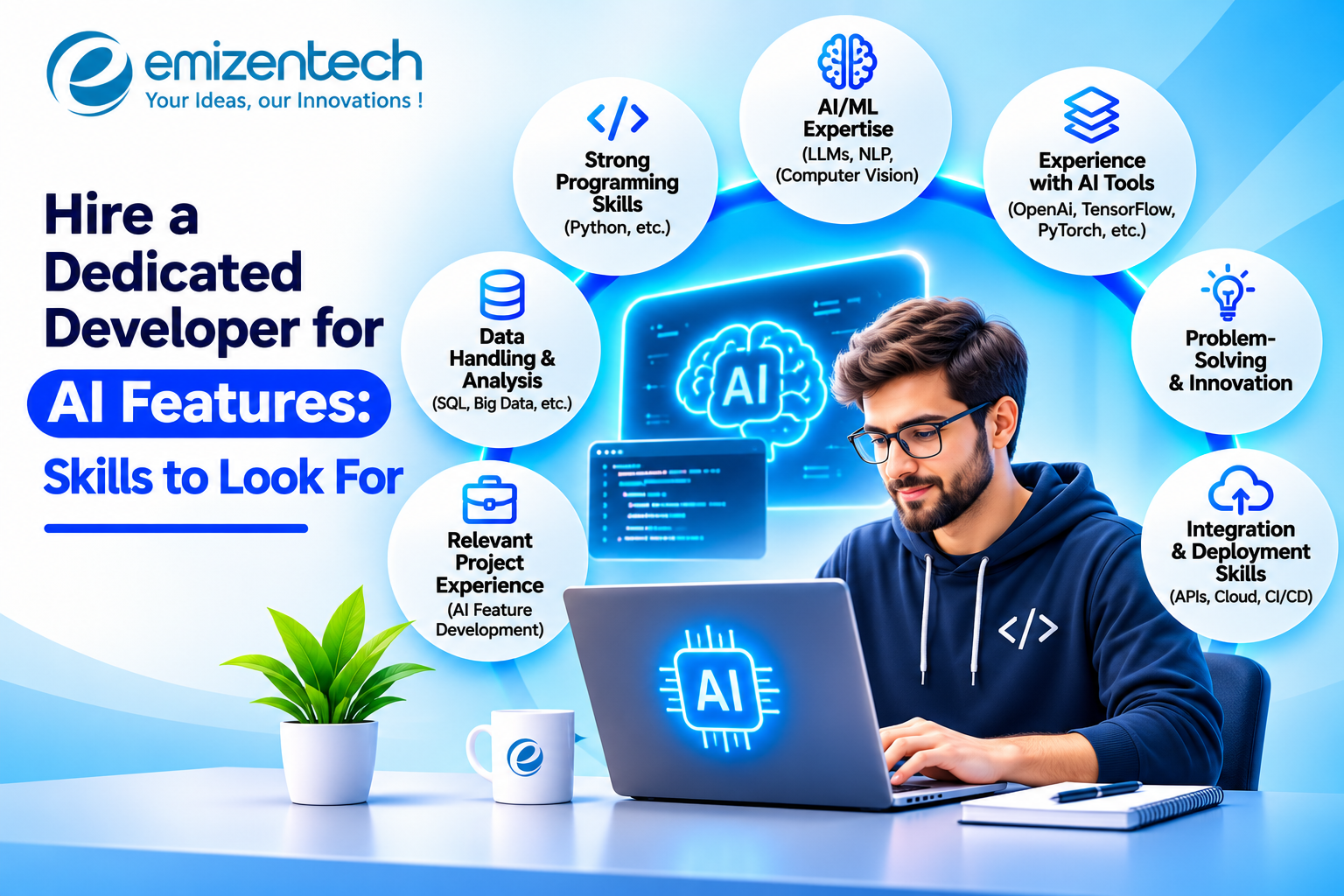
Getting AI features right comes down to hiring for the real skills: data handling, model integration, RAG, backend engineering, deployment, and a healthy respect for security. Test those skills with real tasks, not just interviews, and favor someone who'll stay long enough to learn your product.
If you'd rather not run that search from scratch, EmizenTech works with pre-vetted developers who've built AI features across a range of stacks, and the 14-day money-back guarantee lets you see how the fit feels before you're fully committed.
Do I need a machine learning engineer or a regular developer with AI experience?
It depends on the feature. If you're integrating existing models for chat, search, or summarizing, a strong backend developer with LLM experience is usually enough. If you need custom model training or specialized prediction, bring in someone with deeper ML background.
How much does it cost to hire a dedicated developer for AI work in the US?
Rates vary a lot by experience and region. US-based senior AI developers often run well above $100 an hour, while nearshore and offshore dedicated models can cost far less. The right answer depends on your timeline, how complex the feature is, and how much oversight you can give.
How long does it take to build an AI feature?
A simple integration, like a support chatbot on top of an existing model, can take a few weeks. A RAG system with your own data, testing, and security work often takes two to four months. Plan extra time for evaluation, because that's where most surprises show up.
Can one developer handle the whole AI feature?
For smaller features, yes. Larger builds may need a second person for data engineering or design. A good dedicated developer will tell you honestly when the scope outgrows one person.
What's the biggest mistake teams make when hiring for AI?
Hiring based on buzzwords instead of proof. Someone who has shipped, monitored, and fixed an AI feature in production is worth far more than someone who has only run tutorials.